When companies talk about introducing AI into their systems, the conversation almost always starts with the user interface.
“Let’s add a chatbot.”
“Let’s improve UX with AI suggestions.”
“Let’s automate reports.”
All valid ideas, but they miss the most powerful and strategic opportunity:
The API layer.
If your system has a well-defined API architecture, you already have the perfect foundation to introduce AI in a controlled, scalable, and high-impact way without rewriting everything from scratch.
Why the API Layer Is the Perfect Entry Point for AI
APIs are the backbone of modern systems. They:
- Expose business capabilities
- Orchestrate workflows
- Integrate with external systems
- Control access to data
In other words, APIs define what your system can do.
So instead of asking:
“How do we add AI to the UI?”
A better question is:
“How do we make our APIs intelligent?”
From Rigid Endpoints to Intelligent Capabilities
Traditional APIs are rigid by design.
You call:
GET /projects?status=delayedAnd you get exactly what you asked for – nothing more, nothing less.
But business users don’t think in endpoints. They think in intent:
“Which projects are at risk, and why?”
By introducing an AI layer above your APIs, you can bridge this gap.
Instead of forcing users (or external systems) to understand your API structure, you allow them to express intent, and let AI translate that into the right sequence of API calls.
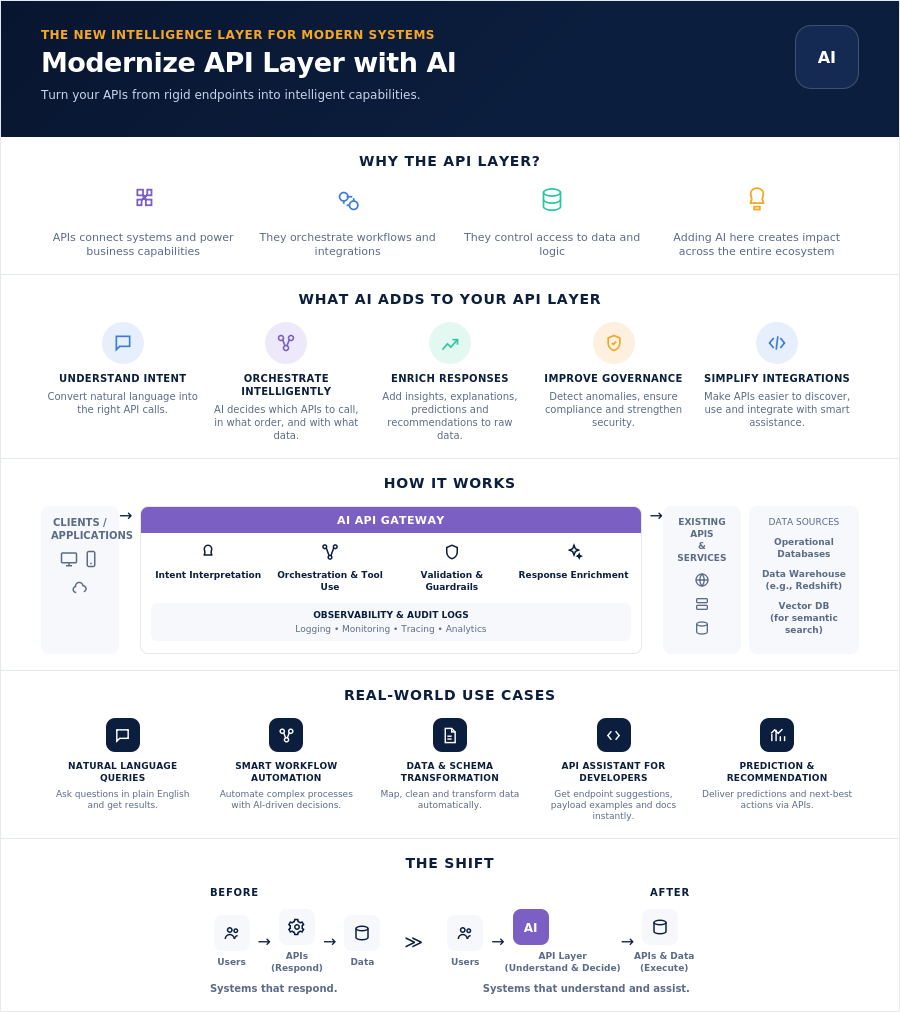
This is where the concept of an AI Gateway comes in.
The AI Gateway: A New Layer of Intelligence
An AI Gateway sits between your clients and your existing APIs.
It doesn’t replace your APIs. It uses them.
Its responsibilities include:
- Interpreting natural language requests
- Mapping intent to API calls
- Orchestrating multi-step workflows
- Validating and enriching responses
Think of it as a smart orchestration layer that turns your APIs into a capability platform, not just a collection of endpoints.
Turning APIs into “Tools” for AI
One of the most effective patterns is to expose your APIs as structured “tools” that AI can use.
For example:
getProjectsAtRiskcreateInvoice
Each tool:
- Has a clear purpose
- Maps to a real API endpoint
- Enforces validation and security
The AI doesn’t access your database.
It doesn’t execute arbitrary logic.
It simply decides:
- Which tool to use
- In what order
- With which parameters
This keeps your system secure, predictable, and auditable.
Smarter Workflows Without Hardcoding
Legacy systems often contain complex orchestration logic:
- If X, then call API A
- Then API B
- Then API C
Over time, this becomes brittle and hard to maintain.
With AI in the API layer, you can shift from:
Hardcoded workflows
To:
Adaptive, context-aware orchestration
For example:
“Approve all invoices below 500€ for trusted clients”
Instead of writing dozens of rules, AI:
- Identifies relevant invoices
- Applies business context
- Calls the appropriate APIs
You still control executio, but the decision-making becomes flexible.
Enhancing APIs with Insight, Not Just Data
Another major opportunity is response enrichment.
Most APIs return raw data:
{ "utilization": 72 }But decision-makers need context:
- Is that good or bad?
- What caused it?
- What will happen next?
AI can enhance API responses with:
- Explanations
- Trends
- Predictions
- Recommendations
Your APIs evolve from:
Data providers
Into:
Decision-support systems
Simplifying Integrations with Semantic APIs
External integrations are often painful:
- Poor documentation
- Complex payloads
- Long onboarding cycles
AI can dramatically reduce this friction.
Imagine a partner asking:
“How do I create a project with assigned resources?”
Instead of digging through documentation, they get:
- The correct endpoint
- Required parameters
- Example payload
- Suggested flow
This transforms your API ecosystem into something that is:
- Discoverable
- Self-explanatory
- Faster to integrate
Data Transformation Without the Headaches
APIs often spend more time transforming data than delivering value.
Different systems send:
- Different field names
- Different formats
- Inconsistent structures
AI can act as a flexible transformation layer:
- Mapping schemas
- Normalizing inputs
- Cleaning data
This reduces the need for endless custom mapping logic and makes integrations more resilient.
Governance, Security, and Control
Introducing AI into APIs doesn’t mean losing control.
In fact, the opposite is true if designed correctly.
Key principles:
- AI can only call whitelisted APIs (tools)
- All actions are logged and auditable
- Critical operations require human approval
- No direct database access from AI
This ensures:
- Security
- Compliance
- Traceability
A Practical Migration Strategy
You don’t need a full rewrite.
A realistic approach looks like this:
Phase 1:
Introduce an AI Gateway with a small set of APIs exposed as tools
Phase 2:
Enable simple orchestration and natural language queries
Phase 3:
Add response enrichment and insights
Phase 4:
Expand to workflow automation with human-in-the-loop controls
This allows you to modernize incrementally while delivering value early.
The Strategic Shift
The real transformation is not technical, it’s conceptual.
You move from:
APIs as endpoints
To:
APIs as capabilities
And from:
Systems that respond
To:
Systems that understand and assist
Closure…
Most organizations are looking at AI as a feature.
But when applied at the API layer, AI becomes something much more powerful:
A decision and orchestration layer that sits on top of your entire system.
And the best part?
If you already have APIs – you’re halfway there.
Here an infographic cheatsheet you can download:

Leave a Reply