When “Good” Requirement Gathering Is Not the Problem
Let’s acknowledge something upfront.
In certain industries, requirement gathering is not naive. It is disciplined, structured, and deeply embedded in how organizations operate.
- Users are trained to articulate their needs clearly
- Business Analysts and Product Owners rigorously challenge assumptions
- Every requirement is traceable, reviewed, and approved
- Documentation is not optional, it is essential for accountability, compliance, and auditability
This is not chaos. This is maturity.
And yet… even here, the cracks are starting to show.
Not because the process is poorly executed, but because the world around it has changed faster than the process itself.
The Hidden Cost of Certainty
In regulated environments, documentation is more than communication – it is evidence.
It proves that:
- Decisions were made intentionally
- Risks were considered
- Controls were applied
- Outcomes can be traced back to defined inputs
To achieve this, requirement gathering aims for a high level of upfront certainty.
But here’s the uncomfortable truth:
The more effort we invest in proving certainty upfront, the harder it becomes to adapt later.
Even when:
- The original understanding was correct
- The analysis was thorough
- The approvals were justified
Reality still evolves.
And when it does, the system resists change, not because it shouldn’t change, but because change is expensive in a system optimized for stability and traceability.
The result?
- Teams hesitate to explore alternatives
- New insights are delayed or deprioritized
- “Correct” requirements outlive their usefulness
Not because they are wrong but because they are no longer relevant.
AI Introduces a New Kind of Evidence
Traditionally, evidence meant documentation.
Signed-off requirements. Approved designs. Verified test cases.
But AI introduces a new form of evidence:
Observed behavior at scale.
Today, we can:
- Generate working solutions rapidly enough to test real scenarios early
- Capture how users actually interact – not how they say they will
- Identify patterns, friction points, and unintended consequences quickly
- Iterate while maintaining full traceability of what changed and why
This doesn’t eliminate the need for documentation.
But it challenges its role.
Because now we can complement (or even replace parts of) static documentation with:
- Recorded interactions
- Measurable outcomes
- Versioned experiments
- Data-backed decisions
In other words:
Evidence is no longer just what we planned, it’s what actually happened.
The Real Tension: Control vs Learning
Highly governed environments are designed around control:
- Define before you build
- Approve before you implement
- Validate against predefined expectations
AI-enabled development introduces a competing force:
- Explore before you define
- Learn before you commit
- Adapt based on evidence
This creates a fundamental tension.
Not between compliance and innovation but between:
Control of intent vs learning from reality
And right now, most organizations are trying to preserve control… while quietly needing faster learning.
That’s why we see:
- Detailed requirements still being produced
- Prototypes being built anyway (often informally)
- Insights emerging outside of formal processes
- Documentation catching up after decisions are already made
This is not a failure of discipline.
It is a signal that the model is evolving.
From Documentation-First to Evidence-First
The future is not “less documentation.”
It is different documentation.
Instead of documenting what we believe will happen, we begin to document:
- What we tested
- What we observed
- What we learned
- Why we changed direction
This is a subtle but critical shift:
From:
“We defined it correctly.”
To:
“We validated it continuously.”
In this model:
- A requirement is not complete when it is approved
- It is complete when it has been proven in practice
And the documentation evolves alongside that proof.
What Should We Start Changing (Without Breaking Compliance)?
This is where the shift must be pragmatic.
Not revolutionary. Not disruptive for the sake of it.
But deliberate.
1. Treat Requirements as Versioned Hypotheses
Even approved requirements should be treated as current best understanding, not final truth.
Version them. Evolve them. Justify changes with evidence.
2. Introduce Prototyping Into the Formal Process
Make early experimentation visible and auditable.
Instead of informal prototypes, create:
- Controlled, traceable experiments
- Documented assumptions behind each iteration
- Clear links between insights and requirement updates
3. Expand the Definition of “Validation”
Validation should not only confirm that the system meets predefined requirements.
It should also confirm that:
- The requirements themselves were correct
- The intended outcomes are actually achieved
- No unintended risks or behaviors emerge
4. Capture Behavioral Evidence as First-Class Artifacts
Logs, user interactions, and outcome metrics should be treated as: compliance-relevant evidence, not just operational data.
5. Shorten the Feedback Loop—Within Governance
Instead of long cycles of definition → approval → implementation:
- Introduce smaller, controlled learning cycles
- Embed checkpoints that allow adaptation without losing traceability
- Design governance to support iteration, not block it
Thought…
The era of gathering user requirements is not over because regulated environments were doing it poorly.
In fact, they were doing it better than most.
But even the best possible upfront understanding cannot compete with fast, evidence-based learning.
The shift is not from discipline to chaos.
It is from predictive certainty to traceable learning.
And the organizations that figure out how to make that shift without losing control will not just stay compliant.
They will become significantly more effective than those who don’t.
Appendix
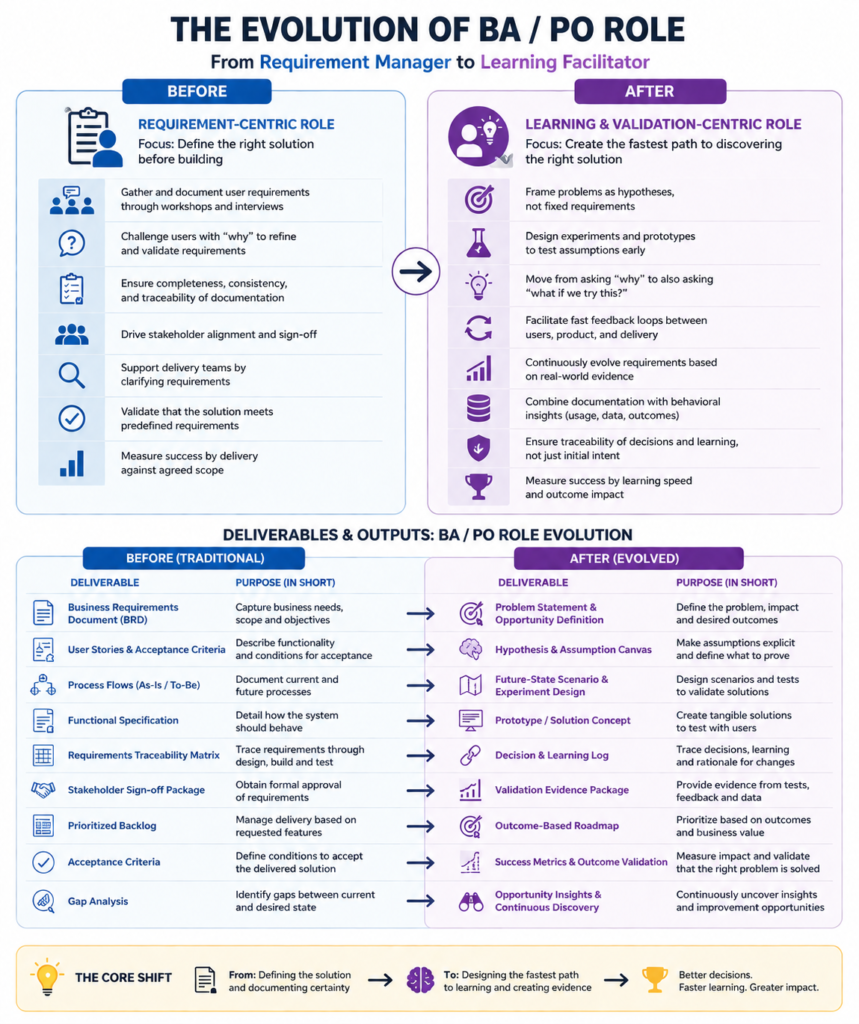
Deliverables & Outputs: BA / PO Role Evolution
| Before (Requirement-Centric) | After (Learning & Validation-Centric) |
|---|---|
| Business requirements documents | Problem statements and opportunity definitions |
| User stories with detailed acceptance criteria | Hypotheses, assumptions, and expected outcomes |
| Process flows describing the current and future state | Experiment designs and validated future-state scenarios |
| Functional specifications | Prototypes, mockups, and tested solution concepts |
| Requirements traceability matrix | Decision and learning traceability (why decisions changed) |
| Stakeholder approvals and sign-offs | Evidence from validation cycles and stakeholder feedback |
| Prioritized backlog based on requested features | Prioritized backlog based on business value, evidence, and impact |
| Acceptance criteria proving the solution was built correctly | Success metrics proving the right problem was solved |
| Gap analysis between current and desired state | Opportunity analysis and continuous improvement insights |
| Documentation as the primary knowledge source | Documentation supported by prototypes, data, and behavioral insights |
The Core Shift
From producing artifacts that describe what should be built:
- Requirements → Specifications → Stories → Acceptance Criteria
To producing artifacts that reduce uncertainty:
- Problem → Hypothesis → Experiment → Evidence → Decision
In a regulated environment, the change is not “less documentation” but different documentation:
Before:
- “Here is what we decided to build and why we believe it is correct.”
After:
- “Here is what we believed, how we tested it, what evidence we collected, and why we evolved the solution.”
The BA/PO becomes responsible not only for capturing intent, but for creating a traceable chain from problem → decision → evidence → outcome.
Below is a practical view of how the BA / PO deliverables evolve, including a short purpose description and an example structure (table of contents). The “after” deliverables are not meant to replace governance artifacts completely, but to shift the focus from documenting certainty to documenting learning.
| Deliverable | Purpose | Example content / structure |
|---|---|---|
| Business Requirements Document (BRD) (Before) | Capture business needs, scope, and expected capabilities before development starts. | 1. Business Context 2. Problem Statement 3. Business Objectives 4. Stakeholders 5. Scope / Out of Scope 6. Business Requirements List 7. Assumptions & Constraints 8. Approval History |
| Problem Statement & Opportunity Definition (After) | Clearly define the problem worth solving without prematurely deciding on the solution. | 1. Current Situation 2. User / Business Pain Point 3. Impact of the Problem 4. Who Experiences It 5. Desired Outcome 6. Business Opportunity 7. Known Constraints 8. Success Indicators |
| User Stories & Acceptance Criteria (Before) | Describe system behavior and define conditions for accepting delivered functionality. | 1. Epic Description 2. User Story Format (“As a…, I want…, so that…”) 3. Business Rules 4. Acceptance Criteria 5. Dependencies 6. Priority |
| Hypothesis & Assumption Canvas (After) | Make uncertainty explicit and define what needs to be proven before investing heavily. | 1. Problem Hypothesis 2. Solution Hypothesis 3. Key Assumptions 4. Risks if Wrong 5. Expected User Behavior 6. Validation Method 7. Success Criteria |
| Process Flows (As-Is / To-Be) (Before) | Document current processes and define the expected future process. | 1. Process Overview 2. Actors & Roles 3. Current Process Flow 4. Pain Points 5. Future Process Flow 6. Business Rules 7. Exceptions |
| Future-State Scenario & Experiment Design (After) | Define possible solutions and how they will be tested before committing to implementation. | 1. Scenario Description 2. User Journey 3. Proposed Solution Concept 4. Expected Behavior 5. Experiment Setup 6. Test Participants7 . Evaluation Criteria |
| Functional Specification (Before) | Describe in detail how the system should behave. | 1. Feature Overview 2. Functional Requirements 3. User Interactions 4. Business Rules 5. Data Requirements 6. Error Handling 7. Integration Points |
| Prototype / Solution Concept (After) | Create something tangible that users and stakeholders can evaluate before development. | 1. Problem Addressed 2. Prototype Overview 3. User Flow 4. Key Screens / Interactions 5. Alternative Solutions Considered 6. Feedback Collected 7. Decision & Next Steps |
| Requirements Traceability Matrix (RTM) (Before) | Demonstrate that requirements are covered through design, development, and testing. | 1. Requirement ID 2. Business Requirement 3. Functional Requirement 4. Design Reference 5. Test Case Reference 6. Status |
| Decision & Learning Log (After) | Maintain traceability of decisions, assumptions, experiments, and evidence behind changes. | 1. Decision Date 2. Decision Made 3. Context 4. Options Considered 5. Evidence Used 6. Decision Owner 7. Expected Impact 8. Follow-up Actions |
| Stakeholder Sign-off Package (Before) | Obtain formal approval that requirements are understood and accepted. | 1. Scope Confirmation 2. Requirement Approval 3. Open Questions 4. Risks 5. Approval Records |
| Validation Evidence Package (After) | Provide evidence that the proposed solution achieves intended outcomes. | 1. Hypothesis Tested 2. Validation Method 3. Prototype / Version Tested 4. User Feedback 5. Usage Data 6. Findings 7. Decision Based on Evidence |
| Prioritized Backlog (Before) | Manage delivery scope based on business priorities and requirements. | 1. Epic List 2. User Stories 3. Priority 4. Estimates 5. Dependencies 6. Release Plan |
| Outcome-Based Roadmap (After) | Align delivery around business outcomes rather than predefined features. | 1. Strategic Goals 2. User Problems 3. Desired Outcomes 4. Success Metrics 5. Experiments Planned 6. Validated Capabilities 7. Future Opportunities |
| Acceptance Criteria (Before) | Define whether delivered functionality meets expectations. | 1. Given/When/Then Scenarios 2. Functional Rules 3. Validation Conditions 4. Exceptions |
| Success Metrics & Outcome Validation (After) | Measure whether the solution actually creates value after release. | 1. Expected Outcome 2. Business KPIs 3. User Behavior Metrics 4. Adoption Metrics 5. Quality Indicators 6. Continuous Improvement Actions |
The overall transformation:
Traditional BA/PO output:
- “A complete description of what we agreed to build.”
Evolved BA/PO output:
- “A traceable journey showing what problem we identified, what we believed would solve it, how we tested it, what we learned, and why we chose the solution we implemented.”
For highly regulated environments, this evolution is actually an opportunity: the audit trail becomes richer – not because there is more documentation, but because the documentation captures the reasoning and evidence behind decisions, not only the final approved requirement.

Leave a Reply