What if learning no longer meant reading hundreds of pages, but having a personal mentor who adapts to the way you think, what you already know, and what you want to discover next?
I’ve explored how artificial intelligence can be applied in business. One of the most valuable things discovered isn’t just what AI can do for businesses. It’s what it can do for the way I learn.
For me, this has become one of the biggest advantages AI has given me (so far).
Not because it magically makes learning effortless, or because it can replace expertise. The real advantage is that it allows me to take control of my learning process in a way that was difficult, time-consuming, or simply impractical before.
From reading books to having a personal mentor
Traditional learning often follows a predefined path. You pick a book, enroll in a course, or follow a structured curriculum. The content is prepared for a broad audience, so it has to accommodate people with different levels of knowledge, backgrounds, and interests.
The problem? You don’t necessarily need all of it.
You might already understand half the material. Some chapters repeat concepts you know well, while others barely touch on the questions you actually want answered. And just when you reach something genuinely interesting, the book moves on.
AI changes this dynamic.
I can ask it to prepare learning materials tailored to my current level of understanding, explain a concept from different perspectives, create practical exercises, or develop a learning path around a specific objective.
I can ask questions, challenge the answers, request clarification, and keep exploring until a concept really clicks.
It’s remarkably close to having a personal mentor available whenever I need one.
Of course, AI isn’t an infallible mentor. It can make mistakes, oversimplify complex topics, or confidently provide incorrect information. But when used critically, with verification and a willingness to question its answers, it becomes an incredibly useful learning partner.
Spend less time on what you know. More time on what you don’t.
One of the most frustrating aspects of traditional learning is the time spent covering familiar ground just to reach the material you actually need.
With AI, I can start where I am.
If I understand the fundamentals, I can move straight to more advanced concepts. If I discover a gap in my knowledge, I can pause and explore it. If something unexpected catches my attention, I can follow that curiosity without losing the thread of my original learning objective.
The learning process becomes dynamic rather than linear.
Instead of following a fixed sequence of chapters, I navigate through a subject based on what I already understand, what I need to improve, and what I find interesting.
For example, when exploring AI and machine learning, I don’t have to study every concept in a predefined order. I can ask for an explanation of a particular technique, compare it with an alternative, examine a business use case, and then work through a practical exercise.
If the exercise reveals that I don’t fully understand an underlying concept, I can go back and address that gap immediately.
This is a much more efficient use of my time and attention.
The goal isn’t to learn less. It’s to spend more of my learning time on what actually moves me forward.
Theory is useful. Practice makes it stick.
Understanding a concept intellectually is not the same as knowing how to apply it.
That’s why one of the most useful things I can do with AI is combine theoretical learning with practical exercises.
I can ask for a concept to be explained, followed by an example, a real-world scenario, and an exercise that requires me to apply what I’ve learned. I can then discuss my solution, identify mistakes, and try a more challenging variation.
This creates a continuous feedback loop:
- Learn a concept.
- See how it works in practice.
- Apply it to a problem.
- Evaluate the result.
- Identify gaps and repeat.
The exercises can be adapted to my level, my professional background, and the context in which I want to use the knowledge.
That last part is particularly important. Learning becomes more meaningful when I can connect a new concept to something I already understand or a problem I might encounter in real life.
AI can help bridge the gap between knowing about something and knowing how to use it.
Learning the same thing from different perspectives
Another advantage I’ve come to appreciate is the ability to explore the same subject through multiple explanations, sources, and examples.
A single explanation rarely captures the full picture. One author might explain a concept brilliantly from a theoretical perspective, while another makes it understandable through practical examples. A third might challenge the assumptions behind both.
AI makes it easy to explore these different angles.
I can ask for an explanation using an analogy, then request a more technical treatment. I can compare competing approaches, examine their strengths and weaknesses, and look at how the same concept applies across different industries.
I can also use AI to identify useful books, articles, research papers, and other sources, then compare what those sources say rather than relying on one explanation.
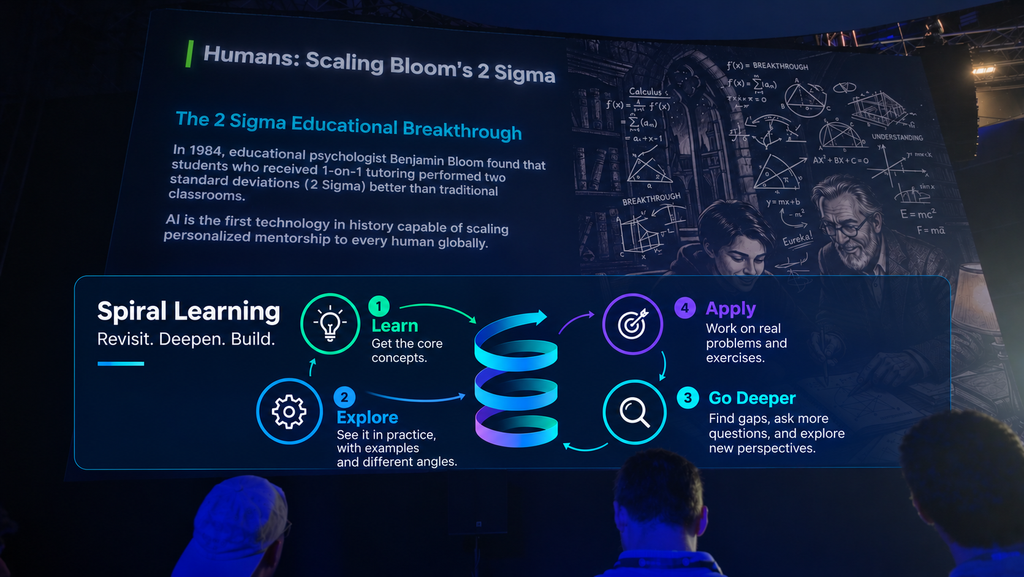
This connects closely with the idea of spiral learning: revisiting a subject multiple times, with each pass adding depth, context, and complexity.
Instead of trying to understand everything perfectly the first time, I build understanding progressively.
I might start with the basics, revisit the subject through a practical example, explore a more advanced application, and later return to the original concept with a much richer perspective.
Each cycle reinforces what I already know while introducing something new.
AI is particularly useful here because I can control the pace and direction of those cycles. I can go deeper when necessary, move sideways into related subjects, or revisit the fundamentals when I realize they deserve another look.
And because different explanations reveal different aspects of a subject, I often develop a more complete understanding than I would from following a single source alone.
The real advantage isn’t AI. It’s how you use it.
It’s tempting to think that AI makes learning easier simply because it can generate explanations and answer questions.
I think the bigger advantage is more subtle.
AI gives me greater control over the learning process itself.
I decide where to start, what to skip, which questions to investigate, how deeply to explore a topic, and when to move from theory to practice.
I can adapt the material as my understanding evolves instead of being constrained by a curriculum designed for an average learner.
But this flexibility comes with responsibility.
It’s easy to confuse a clear explanation with genuine understanding. It’s also easy to stay within a comfortable loop of asking questions and reading answers without ever testing what you’ve learned.
That’s why I believe effective AI-assisted learning needs three things:
- Curiosity — the willingness to ask questions, explore unfamiliar territory, and follow unexpected connections.
- Critical thinking — the ability to challenge explanations, verify facts, compare sources, and recognize uncertainty.
- Application — the discipline to test knowledge through exercises, experiments, and real-world problems.
Without these, AI can become little more than an endless source of information. With them, it can become a powerful learning accelerator.
A new way to approach lifelong learning
I’ve spent decades working in IT, moving between development, consulting, business analysis, architecture, project management, and leadership. Throughout that time, continuous learning has been essential.
Technology changes. Business challenges evolve. New disciplines emerge, and existing knowledge needs to be reconsidered.
The ability to learn efficiently has always mattered. What has changed is how much we can personalize that process.
I no longer have to choose between a rigid curriculum and an unstructured search through countless resources. I can combine structured learning, practical exercises, diverse perspectives, and individual exploration into a process that evolves with me.
I still read books. I still value experienced professionals, high-quality courses, and authoritative sources. AI doesn’t make those things obsolete.
Instead, it helps me get more out of them.
It helps me identify what I need to learn, navigate toward the most relevant material, and turn information into practical understanding.
And perhaps that’s the most important shift: learning becomes less about consuming information and more about actively building knowledge.
My takeaway
I don’t see AI as a shortcut that allows me to avoid the work of learning. I see it as a tool that helps me direct that work where it matters most.
A personalized mentor. A flexible learning environment. A source of alternative perspectives. A generator of practical exercises. A partner in exploring questions I haven’t even thought to ask yet.
Used well, it makes learning more personal, more interactive, and more closely connected to the problems I want to solve.
For me, that is one of the most significant advantages AI has brought so far.
And I suspect we’re only beginning to discover what’s possible.

Leave a Reply